
 EN
EN



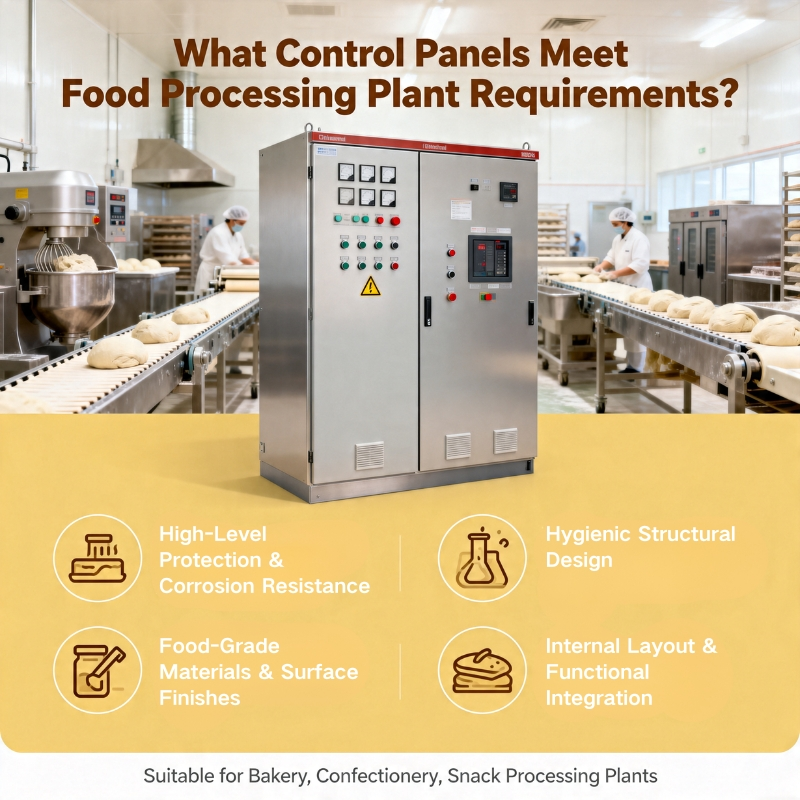
Food processing environments are among the harshest for electrical control equipment. Between daily high-pressure washdowns, exposure to acids and cleaning chemicals, temperature fluctuations, and strict food safety audits, standard industrial control panels simply do not survive — and worse, they can become contamination risks.
So what control panels are truly built to meet food processing plant requirements? The answer goes far beyond a simple IP rating. As a complete control cabinet solution provider serving the food and beverage industry, we break down the five essential characteristics of a food-grade control panel.
1. Hygienic Enclosure Design: No Places for Bacteria to Hide
In a food plant, every surface matters. A standard control cabinet with exposed screws, sharp corners, and external handles is a contamination hazard. Food-grade control panels must follow hygienic design principles:
Fully welded, seam-free construction – Eliminates gaps where food particles or bacteria can accumulate.
Smooth, rounded corners (radius ≥ 3 mm) – Prevents buildup and makes cleaning effective.
Sloped tops (minimum 15°) – Prevents liquids from pooling on top of the cabinet.
Flush-mounted door hinges and latches – No external brackets or crevices.
No exposed threads or protruding bolts – All fasteners should be countersunk or covered.
Regulatory alignment: These design features help you meet good manufacturing practices (GMPs).
2. Material Selection: Why 304 and 316 Stainless Steel Are NonNegotiable
The enclosure material must withstand daily caustic cleaning agents, chlorinated sanitizers, and acidic food residues.
|
Material |
Corrosion Resistance |
Best For |
|
304 Stainless Steel |
Good resistance to mild chemicals and humidity |
Dry processing areas, dairy, bakery (nondirect washdown) |
|
316 Stainless Steel |
Excellent resistance to chlorides, acids, and highsalt environments |
Meat/poultry processing, seafood, pickling, areas with frequent caustic washdowns |
|
Powder-coated carbon steel |
Not recommended for food processing |
Avoid – coating will fail over time |
Our standard: For most food processing lines, we recommend 304 stainless steel for dry-to-damp areas, and 316 stainless steel for wet zones, brine exposure, or high-sanitizer environments.
3. High-Pressure Washdown Protection: IP66, IP69, and IP69K
Food plants are cleaned daily — sometimes multiple times — with hot water (up to 80°C / 176°F) and high-pressure spray (up to 1450 psi).
IP66 (powerful water jets, no ingress).
Recommended for direct washdown: IP69K – tested against high-pressure, high-temperature steam cleaning.
IP69K enclosures use specialized gaskets (food-grade silicone), captive screws, and pressure-compensation valves to prevent internal condensation.
All cable entry points must use stainless steel compression glands with IP69K ratings.
4. Cooling Without Contamination: Closed-Loop vs. Air-to-Air
Traditional fan-and-filter cooling draws in ambient air — which in a food plant contains moisture, cleaning vapors, and even airborne fats. This quickly destroys internal components and bypasses your hygiene efforts.
Food-safe thermal management options:
|
Method |
How It Works |
Pros |
Cons |
|
Closed-loop air conditioner |
Cools internal air without outside exchange |
No contamination; maintains IP69K integrity |
Higher initial cost |
|
Air-to-air heat exchanger |
Transfers heat through sealed core |
Zero outside air entry; low maintenance |
Less cooling capacity for high-heat loads |
|
Passive cooling |
Large enclosure surface area |
No moving parts; lowest cost |
Works only for low-power PLCs/HMIs |
5. Component Selection: Food-Grade, Condensation-Proof, and Traceable
The internal components matter as much as the enclosure. We specify:
Conformal-coated circuit boards – Protects PLCs, power supplies, and drives from residual humidity.
Hermetically sealed relays and contactors – Prevents contact oxidation.
FDA-compliant cable and gasket materials – Silicone gaskets (no phthalates), UL-listed cables with oil-resistant, washdown-rated jackets (e.g., UL 1277, TC-ER).
Full labeling with laser etching – Adhesive labels peel off in wet environments. We laser-etch legends directly onto stainless steel panels and terminal covers.
Why a Standard “Industrial” Panel Fails in Food Processing
Here is what happens when a general-purpose control panel is installed in a food plant:
|
Issue |
Consequence |
|
Water ingress through hinges |
Short circuits, unplanned downtime |
|
Rust from 304 (inadequate grade) |
Contamination risk, failed audits |
|
Open cooling vents |
Mold growth inside panel |
|
Crevices and sharp edges |
Bacteria harborage, non-compliance with GMP |
|
Paper or plastic labels |
Fall off, misidentification during maintenance |
These failures lead to production stops, product recalls, and regulatory fines. The cost of a proper food-grade control panel is almost always lower than one unplanned shutdown.
Ready to upgrade your food processing control infrastructure?
Contact our engineering team for a no-obligation review of your current panel specifications. We will provide a hygienic control panel proposal tailored to your sanitation protocols and production environment.
#Food Processing Control Panel, #Stainless Steel Cabinet, #Hygienic Design, #control panel, #electrical control panel,#Food Safety
Table of Contents
- 1. Hygienic Enclosure Design: No Places for Bacteria to Hide
- 2. Material Selection: Why 304 and 316 Stainless Steel Are NonNegotiable
- 3. High-Pressure Washdown Protection: IP66, IP69, and IP69K
- 4. Cooling Without Contamination: Closed-Loop vs. Air-to-Air
- 5. Component Selection: Food-Grade, Condensation-Proof, and Traceable
- Why a Standard “Industrial” Panel Fails in Food Processing