
 EN
EN



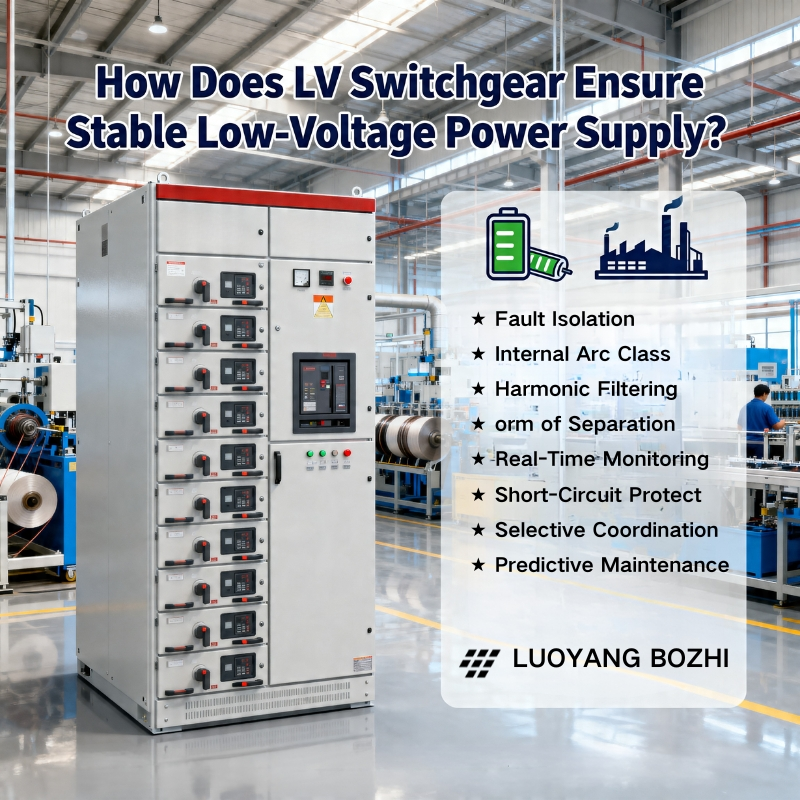
In any industrial facility, commercial building, or renewable energy plant, low voltage (LV) switchgear is the last link between the utility or transformer and your critical loads — motors, lighting, PLCs, HVAC systems, and production lines.
But voltage sags, harmonics, short circuits, and overloads are constant threats. So how does LV switchgear actually ensure a stable low-voltage power supply? The answer lies in a combination of robust design, intelligent protection, and thermal management.
As a complete power distribution solution provider, we break down the six mechanisms that make modern LV switchgear the guardian of electrical stability.
1. Rigid Busbar Systems with High Short-Circuit Withstand
The heart of any LV switchgear is its busbar system — the common conductor that distributes power to all outgoing feeders. Stability starts here.
Copper vs. aluminum: Copper busbars offer lower resistance, better thermal performance, and higher short-circuit withstand. For demanding applications, copper is preferred.
Enclosed and segregated: Phase busbars are fully enclosed in insulated supports, preventing phase-to-phase faults.
High withstand rating: Industrial LV switchgear typically offers short-circuit withstand ratings from 50 kA to 100 kA (1 second). This ensures that even during a downstream fault, busbars do not deform or weld together.
Why this matters: A rigid, high-rated busbar system prevents voltage collapse during fault conditions and maintains supply to healthy feeders.
2. Selective Coordination: Only the Faulty Circuit Trips
One of the biggest causes of “unstable” power is a nuisance trip — where a minor fault on one outlet shuts down an entire production hall. LV switchgear avoids this through selective coordination.
ACBs (Air Circuit Breakers) on incoming and main feeders with adjustable long-time, short-time, and instantaneous trip settings.
MCCBs (Molded Case Circuit Breakers) on outgoing feeders with carefully chosen trip curves.
Fuse combinations for downstream protection.
When designed correctly, a short circuit on a single motor circuit will trip only that MCCB, while the main ACB and other feeders remain online. The result? Stable power supply to unaffected loads.
IEC 60947-2 defines the time-current characteristics for selective coordination. A qualified switchgear manufacturer provides coordination studies as part of the design.
3. Automatic Power Factor Correction (APFC) for Voltage Stability
Low power factor (PF) — caused by induction motors, transformers, and VFDs — leads to voltage drops and increased current. LV switchgear can integrate APFC banks that automatically switch capacitor steps in and out.
How it helps: Maintaining PF above 0.95 reduces line current, stabilizes voltage at the load terminals, and prevents utility penalties.
Controller logic: Modern APFC controllers use thyristor switching (zero-crossing) to avoid transients that could destabilize sensitive equipment.
Without APFC, a large motor start could drag down voltage across the entire low-voltage network. With it, voltage remains within ±5% of nominal.
4. Surge Protection Devices (SPDs) Against Transient Overvoltages
Lightning strikes, switching operations, and grid faults inject voltage spikes that can corrupt PLC logic, damage drives, or trip sensitive breakers. LV switchgear incorporates coordinated SPDs:
Type 1 SPD (at main incoming) – for direct lightning strike energy.
Type 2 SPD (on distribution feeders) – for induced surges.
Type 3 SPD (near sensitive loads) – fine protection.
By clamping transient overvoltages to safe levels (e.g., below 2.5 kV for 230V systems), SPDs prevent nuisance trips and component degradation — directly contributing to supply continuity.
5. Thermal Management: Avoiding Overtemperature-Induced Failures
Heat is the enemy of stability. Every circuit breaker, contactor, and busbar joint has a rated operating temperature. Exceed it, and protective devices may derate or trip prematurely.
Professional LV switchgear ensures stability through:
Ventilation design: Natural or forced convection based on heat dissipation calculations.
Temperature monitoring: Optional RTD sensors on main busbars with alarms before critical limits.
De-rating awareness: Switchgear installed in high ambient temperatures (e.g., >40°C) must be de-rated or fitted with cooling.
Our practice: As a solution provider, we perform thermal simulations to identify hot spots and ensure every outgoing feeder operates within its thermal envelope — even at 80% load.
6. Intelligent Monitoring and Remote Control (IoT-Ready)
Modern LV switchgear is no longer passive. For mission-critical facilities, digital switchgear with power meters and communication gateways provides real-time stability insights:
Voltage monitoring per phase: Instant alarm if any phase deviates beyond set thresholds.
Load shedding logic: Pre-programmed contacts can trip non-critical feeders to preserve supply to essential loads when the main transformer is overloaded.
Remote diagnostics: Maintenance teams receive alerts before a loose connection causes voltage fluctuation or overheating.
This layer of intelligence transforms LV switchgear from a dumb distribution box into an active stability enforcer.
Real-World Example: What Happens Without Proper LV Switchgear?
|
Problem |
Consequence |
|
Poor busbar bracing |
Busbars short together during downstream fault → total blackout |
|
No selective coordination |
A small welder trips the main breaker → whole plant down |
|
Missing APFC |
Low voltage causing motors to overheat and trip |
|
No SPDs |
Lightning surge wipes out PLCs and VFDs → days of downtime |
|
Inadequate ventilation |
Breakers trip at 70% load on a hot summer afternoon |
Each of these failures is preventable with professionally engineered LV switchgear.
Why Choose a Complete LV Switchgear Solution Provider?
Stable low-voltage supply is not achieved by buying individual components (breakers, meters, enclosures) separately. It requires system engineering:
Short-circuit and coordination studies
Thermal sizing and ventilation design
Protection relay programming and testing
Factory acceptance testing (FAT) under simulated fault conditions
As an experienced low-voltage switchgear manufacturer and solution provider, we deliver fully assembled, tested, and certified panels that integrate all six stability mechanisms above. From incoming ACB to final distribution, every element is matched for your specific load profile.
Ensure your facility never suffers a preventable outage.
Contact our engineering team to review your single-line diagram and load list. We will provide a customized LV switchgear solution that guarantees stable, reliable low-voltage power — shift after shift.
From industrial plants to commercial towers — stability is engineered, not hoped for.
#switchgear, #Low Voltage Power Distribution, #Power Stability, #MCCB, #ACB, #Switchgear Design, #Electrical Reliability, #Power Factor Correction,#LV Switchgear,
Table of Contents
- 1. Rigid Busbar Systems with High Short-Circuit Withstand
- 2. Selective Coordination: Only the Faulty Circuit Trips
- 3. Automatic Power Factor Correction (APFC) for Voltage Stability
- 4. Surge Protection Devices (SPDs) Against Transient Overvoltages
- 5. Thermal Management: Avoiding Overtemperature-Induced Failures
- 6. Intelligent Monitoring and Remote Control (IoT-Ready)
- Real-World Example: What Happens Without Proper LV Switchgear?
- Why Choose a Complete LV Switchgear Solution Provider?