
 EN
EN



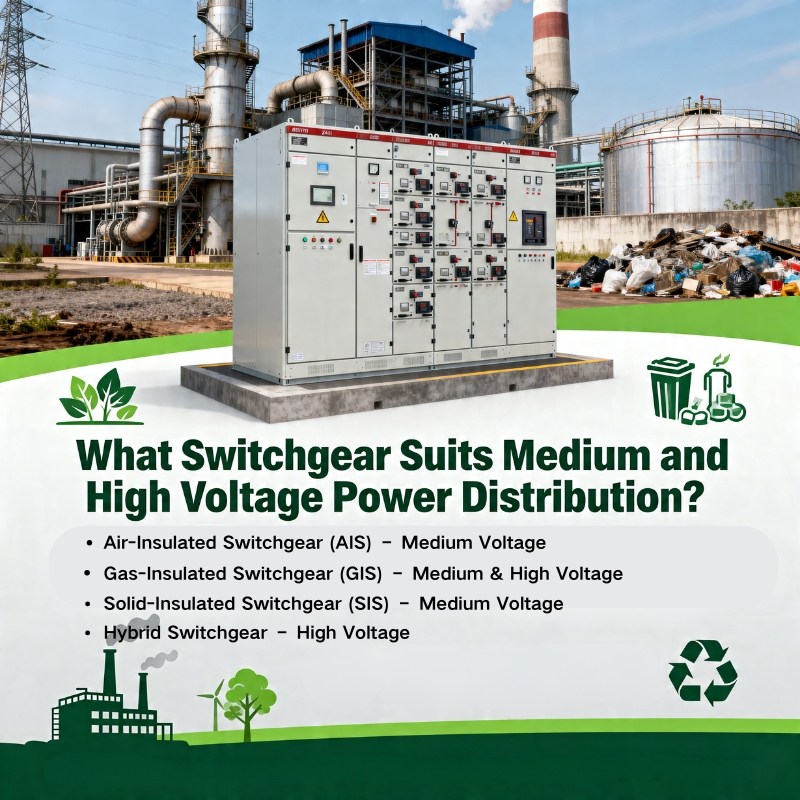
When you are building or upgrading a power distribution system — whether for a data center, a mining operation, a solar farm, or an industrial plant — one of the most critical decisions you will face is which switchgear to use for medium voltage (MV) and high voltage (HV) applications.
Choosing the wrong switchgear can compromise safety, reliability, and operational continuity. As a complete power distribution solution provider specializing in control and switchgear cabinets, we have prepared this guide to help you navigate the key options: AIS, GIS, and their hybrid variants.
1. First, Understand the Voltage Levels
Before selecting switchgear, confirm your system’s voltage class based on IEC or ANSI standards:
Medium Voltage (MV): 1 kV to 52 kV (common levels: 3.3 kV, 6.6 kV, 11 kV, 33 kV)
High Voltage (HV): Above 52 kV up to 300 kV (e.g., 66 kV, 110 kV, 132 kV, 220 kV)
Most industrial and commercial projects fall into the MV range, while HV switchgear is typically found in utility substations, wind farms, and large transmission networks.
2. The Classic Choice: AIS (Air-Insulated Switchgear)
AIS uses ambient air as the primary insulating medium between live parts and ground. It has been the industry workhorse for decades.
✅ Advantages of AIS:
Lower upfront cost – simpler construction, widely available components.
Easy visual inspection – open construction allows thermal imaging and visual checks.
Simple maintenance – most components can be serviced or replaced without special tools.
Well-understood technology – every electrical engineer is familiar with AIS.
❌ Limitations:
Large footprint – requires significant space for clearances (especially at higher voltages).
Susceptible to pollution – dust, salt, and humidity can reduce insulation performance.
Higher maintenance in harsh environments.
Best for:
Indoor substations with ample space
Dry, clean environments (e.g., factories, commercial buildings)
Projects with tight capital budgets
3. The Space-Saving Specialist: GIS (Gas-Insulated Switchgear)
GIS encapsulates all live parts in a sealed metal enclosure filled with SF₆ gas (or eco-friendly alternatives), which has far superior dielectric strength compared to air.
✅ Advantages of GIS:
Extremely compact – up to 90% smaller footprint than AIS for the same voltage level.
High reliability – sealed construction eliminates environmental contamination (salt, dust, insects).
Low maintenance – internal components are protected for decades.
Ideal for harsh conditions – offshore platforms, desert regions, polluted industrial zones, and underground substations.
❌ Limitations:
Higher initial cost – precision manufacturing and gas handling increase investment.
Gas management – requires periodic leak checks and SF₆ handling according to environmental regulations (some regions now mandate SF₆-free alternatives).
Specialized training – maintenance teams need specific knowledge for GIS.
Best for:
Dense urban substations (land is expensive or unavailable)
Offshore wind farms, oil & gas platforms
High-altitude or heavily polluted sites
Projects where uptime is absolutely critical
4. The Best of Both Worlds: Hybrid Switchgear
As the name suggests, hybrid switchgear combines AIS busbars with GIS-style circuit breakers and disconnectors. This configuration offers a balanced solution.
✅ Advantages:
Smaller footprint than pure AIS
Lower cost than full GIS
High reliability for critical bays
❌ Limitations:
Still requires more space than GIS
Less common, so component availability may vary by region
Best for:
Substation expansions where space is limited but not extreme
Retrofit projects upgrading from AIS
5. Ring Main Units (RMUs) – A Special MV Category
For secondary distribution networks (e.g., residential feeders, small industrial parks), an RMU is a compact, sealed switchgear used for loop-fed circuits. Most RMUs are SF₆-insulated or solid-insulated (eco-friendly).
Typical voltage: Up to 24 kV (occasionally 36 kV)
Current rating: Usually up to 630 A
Key advantage: Small, maintenance-free, and suitable for outdoor pad-mounted installations
6. Key Selection Criteria (Beyond Insulation Type)
When deciding which switchgear suits your MV/HV project, ask these questions:
|
Criterion |
AIS |
GIS |
Hybrid |
|
Available space |
Large |
Very small |
Medium |
|
Ambient pollution |
Low |
Any (including severe) |
Moderate to high |
|
Capital budget |
Lower |
Higher |
Medium |
|
Maintenance access |
Frequent visual |
Occasional gas checks |
Moderate |
|
Project location |
Indoor/dry |
Indoor/outdoor/harsh |
Indoor/outdoor |
Additional technical considerations:
Short-circuit withstand rating (kA) – must match your system’s fault level.
Internal arc classification (IAC) – switchgear should be tested to IEC 62271-200 for personnel safety.
Future expansion – AIS makes addition easier; GIS may require pre-planned extension bays.
Environmental regulations – SF₆ is a potent greenhouse gas. Many regions now mandate SF₆-free GIS using vacuum or clean air technology. Always check local compliance.
7. Why Work With a Complete Switchgear Solution Provider?
Selecting MV/HV switchgear is not just about choosing AIS or GIS. It involves:
Coordination studies – protective relay settings, selectivity with downstream panels
Civil interface – cable entry, grounding, and mounting structures
Factory acceptance tests (FAT) and site commissioning
Lifecycle support – spare parts, gas handling, and retrofitting
As an experienced power distribution solution provider, we do not simply sell switchgear – we engineer a complete system from the incoming utility connection down to your final distribution boards. Our turnkey approach ensures:
Proper voltage withstand and insulation coordination
Seamless integration with your existing control cabinets
Full compliance with CE, ISO, or local standards
On-time delivery and professional commissioning
Final Recommendation
Choose AIS if you have ample space, a modest budget, and a clean indoor environment.
Choose GIS if land is expensive, environmental conditions are harsh, or you need maximum reliability with minimal maintenance.
Consider hybrid for expansion projects where space is somewhat constrained but budget cannot support full GIS.
Still unsure which switchgear fits your medium or high voltage power distribution project? Our engineering team is ready to review your single-line diagram and site conditions – free of charge.
#switchgear, #Medium Voltage Switchgear, #High Voltage Power Distribution, #Substation Solutions, #Switchgear Selection, #Power Control Cabinet, #Utility Infrastructure
Table of Contents
- 1. First, Understand the Voltage Levels
- 2. The Classic Choice: AIS (Air-Insulated Switchgear)
- 3. The Space-Saving Specialist: GIS (Gas-Insulated Switchgear)
- 4. The Best of Both Worlds: Hybrid Switchgear
- 5. Ring Main Units (RMUs) – A Special MV Category
- 6. Key Selection Criteria (Beyond Insulation Type)
- 7. Why Work With a Complete Switchgear Solution Provider?
- Final Recommendation