
 EN
EN



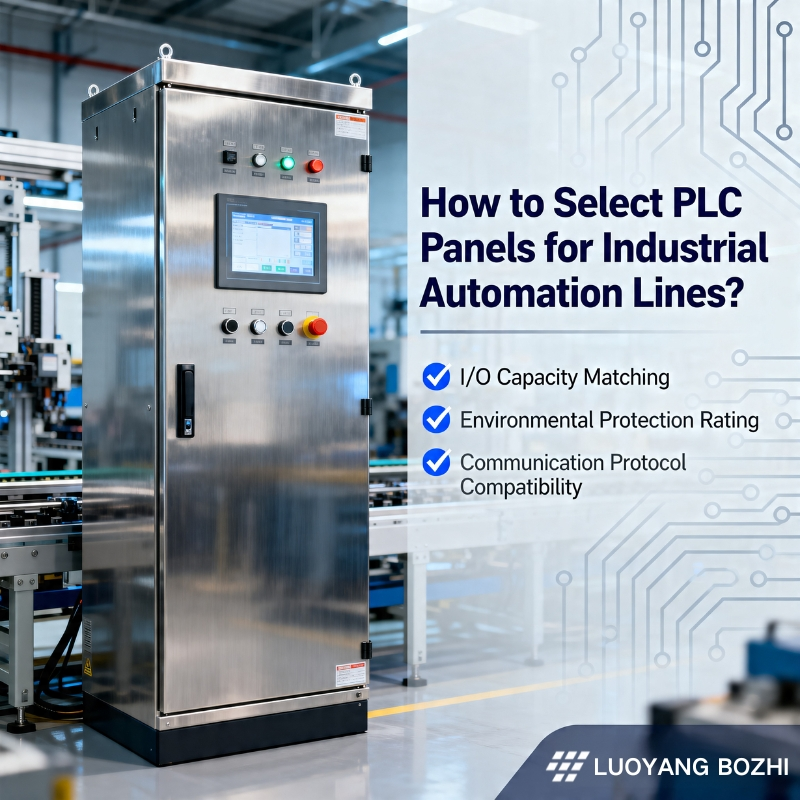
In modern industrial automation lines, the PLC control panel is far more than just a metal box holding electronic components. It serves as the central nervous system of your entire production process. Choosing the wrong panel can lead to unexpected downtime, safety hazards, and costly retrofits.
But with countless suppliers and technical standards on the market, how do you make the right decision? As a complete electrical solutions provider specializing in control and power distribution cabinets, we have compiled this 7-step checklist to help you select the ideal PLC control panel for your automation line.
1. Start with the Environmental Conditions (IP & IK Ratings)
Before evaluating any internal components, assess where the panel will be installed.
Clean indoor environments (e.g., packaging or assembly lines): An IP54 enclosure is typically sufficient, offering protection against dust and splashing water.
Harsh or outdoor environments (e.g., mining, oil & gas, food processing): You need at least IP65 or IP66 for watertight and dust-tight protection. For washdown areas, consider IP69K.
High-impact risk areas: Look for cabinets with an IK10 rating to withstand mechanical impact.
✅ Pro tip from a solution provider: Always select one rating higher than your current requirement. This future-proofs your line against process changes or stricter safety audits.
2. Define Your I/O Count and Future Expansion
The physical size and layout of your PLC panel are dictated by the number of Input/Output (I/O) points.
List all field devices: Sensors, actuators, VFDs, HMIs, and relays.
Add 20–30% spare capacity: Automation lines rarely stay static. Additional I/O modules should be mountable without redesigning the entire backplane.
Consider modular vs. fixed PLCs: Modular PLCs (like Siemens S7-1500 or Rockwell ControlLogix) offer greater flexibility for large lines, while fixed units suit compact, single-purpose machines.
3. Pay Close Attention to Thermal Management
One of the most overlooked factors in panel selection is heat dissipation. PLCs, power supplies, and contactors generate heat, and excessive temperatures reduce component lifespan by up to 50%.
Calculate the heat load (Watts): Sum the heat dissipation of all internal devices.
Choose your cooling strategy:
Natural convection – For small panels with low heat load.
Filter fans – Cost-effective for medium loads, but require regular filter changes.
Air conditioners / heat exchangers – Necessary for large automation lines or high-ambient-temperature environments (e.g., steel mills).
What we do differently: As a turnkey solution provider, we simulate thermal performance using dedicated software to ensure your PLC panel never overheats, even at peak load.
4. Verify Short-Circuit Protection & Power Distribution
A PLC panel is only as reliable as its power distribution design. Ensure the panel includes:
Main circuit breaker – For overall line isolation.
Branch circuit protection – Separate breakers or fuses for PLC power, I/O loops, and field devices.
Surge protection devices (SPD) – Critical for automation lines connected to long sensor cables or exposed to lightning-prone areas.
24V DC power supply with redundancy – For critical automation lines, dual power supplies with a redundancy module prevent single-point failures.
5. Prioritize Wiring Accessibility & Cable Management
Open the door of a poorly designed control panel and you will see a bird’s nest of wires – a nightmare for troubleshooting. A professional PLC panel should feature:
Separate wiring ducts for power and signal cables to avoid electromagnetic interference (EMI).
Removable terminal blocks – Save hours of rewiring during maintenance.
Clear labeling – Every wire, terminal, and component should be marked according to the schematic.
At least 30% spare duct space – For future modifications.
6. Ensure Compliance with International Standards
Global buyers demand compliance. Your PLC control panel must be manufactured and tested according to relevant standards. Always ask your supplier:
IEC 61439-1/2 (low-voltage switchgear and controlgear assemblies)
UL 508A (for North American projects)
NFPA 79 (electrical standard for industrial machinery)
CE marking (for EU markets)
A qualified solution provider will offer third-party test reports and type-test certificates as standard deliverables.
7. Don’t Forget Lifecycle Support & Documentation
The cheapest panel often becomes the most expensive after two years. Evaluate your partner’s after-sales capabilities:
Full as-built documentation – Electrical schematics, BOM, component datasheets, and layout drawings
Remote access capability – Built-in industrial routers for remote diagnostics (Modbus TCP, Profinet, EtherNet/IP).
Global component sourcing – Using globally available brands (Siemens, ABB, Schneider, Mitsubishi) to avoid long lead times for replacements.
Final Thought: Work with a Solutions Provider, Not Just a Box Builder
Selecting a PLC control panel for an industrial automation line is a system engineering task. It is not about buying an empty enclosure but about integrating power distribution, control logic, thermal management, and safety into one optimized package.
As an experienced complete control cabinet solution provider, we don’t just deliver a panel – we deliver a tailored solution that matches your production targets, environmental constraints, and maintenance strategy.
Ready to upgrade your automation line?
Contact our team for a free consultation and a customized PLC panel quotation based on your I/O list and site conditions.
#PLC Control Panel, #Industrial Automation, #Panel Selection Guide, #Thermal Management, #Custom Control Cabinet, #Factory Automation, #Electrical Engineering
Table of Contents
- 1. Start with the Environmental Conditions (IP & IK Ratings)
- 2. Define Your I/O Count and Future Expansion
- 3. Pay Close Attention to Thermal Management
- 4. Verify Short-Circuit Protection & Power Distribution
- 5. Prioritize Wiring Accessibility & Cable Management
- 6. Ensure Compliance with International Standards
- 7. Don’t Forget Lifecycle Support & Documentation
- Final Thought: Work with a Solutions Provider, Not Just a Box Builder